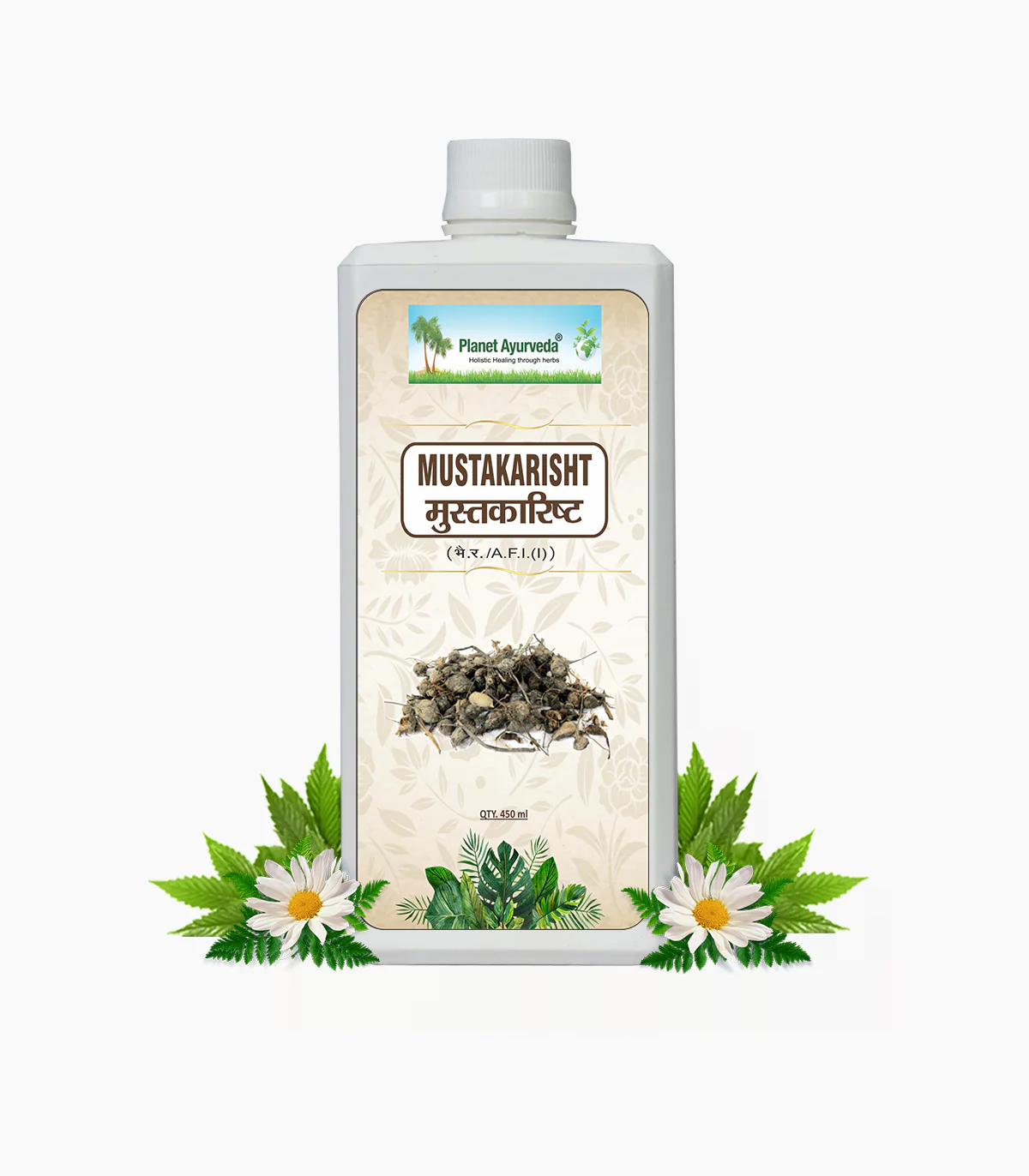
MUSTAKARISHT
Pack Size: 450ml
Dosage: 12 ml to 24 ml once or twice a day after meals or as advised by physician.
[/shortdesc]
[additional]
Each 10 ml contains aqueous extracts derived:
| S. No. | Herb Used | Latin Name | Part Used | Quantity |
| 1. | Nagarmotha | Cyperus rotundus | Root | 100 Parts |
| 2. | Dhataki | Woodfordia fruticosa | Flower Bark | 8 parts |
| 3. | Gur | Saccharum officinarum | 148 parts | |
| 4. | Ajwain | Trachyspermum ammi | Seed | 1 part |
| 5. | Chitrak | Plumbago zeylanica | Root Bark | 1 part |
| 6. | Jeera | Carum carvi | Seed | 1 part |
| 7. | Laung | Syzygium aromaticum | Flower | 1 part |
| 8. | Kali Maricha | Piper nigrum | Seed | 1 part |
| 9. | Sonth | Zingiber officinale | Rhizome | 1 part |
| 10. | Methi | Trigonella foenum graceum | Seed | 1 Part |
| 11. | Water | Aqua | 1025 parts |
Ref. Ayurvedic Text - [ भै. र / A.F.I. (1) ]
[/additional]Asavas and arishtas are Ayurvedic medicinal formulations made by soaking the herbal drugs, in a solution of jaggery or sugar, for a specific period, during which it undergoes a process of fermentation generating alcohol. Mustakarishta is one such ayurvedic herbal formulation in arishta (fermented medicated herbal liquid) form. It has a sweet as well as a bitter taste. Mustakarishta balances the Vata and Kapha doshas and is a Pitta dosha Vardhak. The Arishta is stimulant, stomachic, astringent, and tonic. This is a traditional Ayurvedic formulation with antidiarrheal, antidysenteric, antioxidant, antispasmodic, appetizer, astringents, carminative, digestive, stomachic properties and has been used in many digestive problems for centuries.
Contraindications
- Overdosage of Mustakarishta may cause gastritis.
- In case of increased Pitta, it should be avoided.
- It is advised to avoid it in diabetic people.
MUSTAKARISHT
Pack Size: 450ml
Dosage: 12 ml to 24 ml once or twice a day after meals or as advised by physician.
[/shortdesc]
[additional]
Each 10 ml contains aqueous extracts derived:
| S. No. | Herb Used | Latin Name | Part Used | Quantity |
| 1. | Nagarmotha | Cyperus rotundus | Root | 100 Parts |
| 2. | Dhataki | Woodfordia fruticosa | Flower Bark | 8 parts |
| 3. | Gur | Saccharum officinarum | 148 parts | |
| 4. | Ajwain | Trachyspermum ammi | Seed | 1 part |
| 5. | Chitrak | Plumbago zeylanica | Root Bark | 1 part |
| 6. | Jeera | Carum carvi | Seed | 1 part |
| 7. | Laung | Syzygium aromaticum | Flower | 1 part |
| 8. | Kali Maricha | Piper nigrum | Seed | 1 part |
| 9. | Sonth | Zingiber officinale | Rhizome | 1 part |
| 10. | Methi | Trigonella foenum graceum | Seed | 1 Part |
| 11. | Water | Aqua | 1025 parts |
Ref. Ayurvedic Text - [ भै. र / A.F.I. (1) ]
[/additional]Asavas and arishtas are Ayurvedic medicinal formulations made by soaking the herbal drugs, in a solution of jaggery or sugar, for a specific period, during which it undergoes a process of fermentation generating alcohol. Mustakarishta is one such ayurvedic herbal formulation in arishta (fermented medicated herbal liquid) form. It has a sweet as well as a bitter taste. Mustakarishta balances the Vata and Kapha doshas and is a Pitta dosha Vardhak. The Arishta is stimulant, stomachic, astringent, and tonic. This is a traditional Ayurvedic formulation with antidiarrheal, antidysenteric, antioxidant, antispasmodic, appetizer, astringents, carminative, digestive, stomachic properties and has been used in many digestive problems for centuries.
Contraindications
- Overdosage of Mustakarishta may cause gastritis.
- In case of increased Pitta, it should be avoided.
- It is advised to avoid it in diabetic people.
Product Information
Product Information
Shipping & Returns
Shipping & Returns
Description
Pack Size: 450ml
Dosage: 12 ml to 24 ml once or twice a day after meals or as advised by physician.
[/shortdesc]
[additional]
Each 10 ml contains aqueous extracts derived:
| S. No. | Herb Used | Latin Name | Part Used | Quantity |
| 1. | Nagarmotha | Cyperus rotundus | Root | 100 Parts |
| 2. | Dhataki | Woodfordia fruticosa | Flower Bark | 8 parts |
| 3. | Gur | Saccharum officinarum | 148 parts | |
| 4. | Ajwain | Trachyspermum ammi | Seed | 1 part |
| 5. | Chitrak | Plumbago zeylanica | Root Bark | 1 part |
| 6. | Jeera | Carum carvi | Seed | 1 part |
| 7. | Laung | Syzygium aromaticum | Flower | 1 part |
| 8. | Kali Maricha | Piper nigrum | Seed | 1 part |
| 9. | Sonth | Zingiber officinale | Rhizome | 1 part |
| 10. | Methi | Trigonella foenum graceum | Seed | 1 Part |
| 11. | Water | Aqua | 1025 parts |
Ref. Ayurvedic Text - [ भै. र / A.F.I. (1) ]
[/additional]Asavas and arishtas are Ayurvedic medicinal formulations made by soaking the herbal drugs, in a solution of jaggery or sugar, for a specific period, during which it undergoes a process of fermentation generating alcohol. Mustakarishta is one such ayurvedic herbal formulation in arishta (fermented medicated herbal liquid) form. It has a sweet as well as a bitter taste. Mustakarishta balances the Vata and Kapha doshas and is a Pitta dosha Vardhak. The Arishta is stimulant, stomachic, astringent, and tonic. This is a traditional Ayurvedic formulation with antidiarrheal, antidysenteric, antioxidant, antispasmodic, appetizer, astringents, carminative, digestive, stomachic properties and has been used in many digestive problems for centuries.
Contraindications
- Overdosage of Mustakarishta may cause gastritis.
- In case of increased Pitta, it should be avoided.
- It is advised to avoid it in diabetic people.